
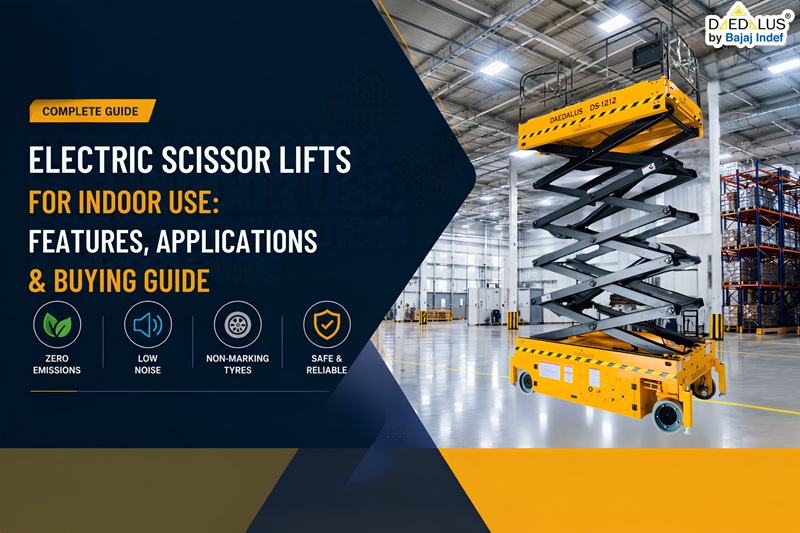
A maintenance manager at a pharmaceutical plant in Pune needs to replace ceiling-mounted HVAC filters at 9 metres. Diesel-powered equipment is ruled out immediately. Fumes in a cleanroom environment, noise restrictions, and polished epoxy flooring make it a non-starter. What he needs is a battery-operated elevated work platform built specifically for slab floors and enclosed spaces.
If you are evaluating height access equipment for a warehouse, factory, hangar, or commercial interior, this guide is for you. It covers what features matter for indoor use, which machine suits each facility type, and the exact questions to ask before you buy or rent. You can also browse Daedalus products directly: Self-Propelled Scissor Lifts, Pushable Scissor Lifts, and Articulating Boom Lifts.
Why Indoor Work at Height Needs a Different Machine
Not every scissor lift is suited for enclosed environments. The three problems that come up most often in Indian industrial facilities are emissions, flooring damage, and noise.
- Diesel and LPG-powered lifts produce exhaust fumes. In pharmaceutical plants, food processing units, data centres, and clean rooms, any combustion is disqualifying.
- Pneumatic tyres chew up epoxy-coated floors and polished concrete. A new warehouse floor can be damaged beyond repair in a single shift.
- Many facilities including IT campuses, hospitals, and occupied office buildings have noise restrictions that make conventional equipment unusable during working hours.
The answer in all three cases is a battery-powered slab scissor lift with solid or foam-filled non-marking tyres. Zero emissions, zero floor damage, low noise output. That is the starting point for any indoor shortlist.
Practical note: Before finalising any machine, verify the GVW (gross vehicle weight) against your floor's rated load capacity. This is one of the most commonly overlooked checks in Indian industrial procurement.
Key Features to Look For
Here is a practical checklist, not a spec dump. Every point maps to a real-world problem that facilities run into after purchase.
Platform Height and Working Reach
Platform height and working height are not the same. Working height is typically platform height plus 1.8 to 2 metres (the operator's reach). A platform at 8m gives you a working reach of around 10m. Match the platform height to your actual task height, not the other way around. For most indoor industrial applications in India, a range of 6m to 14m covers over 90% of requirements.
Platform Capacity and Dimensions
Minimum 250 kg for a single operator with tools. If you regularly send two workers up with equipment, look for 350 kg and above. Platform width matters as much as capacity. Check your narrowest aisle or doorway clearance against the machine's stowed width before shortlisting any model.
Drive System
Self-propelled electric machines are driven by the operator from the ground or the platform. They move themselves between work locations without manual effort. Pushable machines use electric power only for the lift function. The operator manually positions them. The right choice depends on how often you reposition. More than 5 to 6 moves per shift and a self-propelled unit pays for itself in labour time.
Look for proportional drive control. It allows precise, slow movement in tight corridors and near racking, rather than jerky on-off motion that creates collision risk.
Tyre Type
Non-marking solid or foam-filled tyres are the standard for indoor use. They do not puncture, do not leave black marks on polished floors, and do not damage epoxy coatings. Avoid pneumatic tyres in any indoor setting.
Safety Systems
- Tilt protection: prevents operation if the machine is on an uneven surface.
- Electromagnetic brakes: hold the machine stable on a slight incline during elevated work.
- Pothole protection: automatically lowers platform edge guards when the platform is raised, preventing the machine from driving into a floor opening.
Battery and Charging
Can the machine run a full 8-hour shift without a recharge? Ask for the actual cycle count per charge under load, not just idle hours. Inbuilt smart chargers with overcharge protection are significantly better than machines that depend on external chargers. For Indian facilities, confirm the charger is compatible with single-phase 230V supply.
Certification
CE certification to EN 280 is the benchmark for mobile elevated work platforms in India and globally. It covers structural integrity, stability, control systems, and safety device testing. For facilities with EHS audits, CE certification is often a non-negotiable procurement requirement. You can view Daedalus quality certificates here.
Indoor Applications: Which Lift for Which Facility
Use this table as a starting reference. Click any lift type to view the full product range and specifications.
Narrow aisle tip: In warehouses with racking, the machine's stowed width is more critical than its platform size. Always measure your aisle clearance first and filter machines accordingly.
Self-Propelled vs. Pushable: Which One Do You Need?
This is the most common question from procurement teams, and the answer is simpler than most suppliers make it sound.
Choose a self-propelled unit if:
- The machine will be moved frequently between work locations. Browse the DS series self-propelled range.
- Your operators need to drive the platform into position without a second person to push.
- You are working in large facilities like warehouses or hangars where the machine covers significant distances per shift.
Choose a pushable unit if:
- Work is concentrated in one or two fixed zones per shift. See the pushable scissor lift range.
- Floor space is limited and a lighter, narrower machine is needed.
- Budget is a primary concern and repositioning frequency is low.
- Your floor loading capacity is tight and a lighter machine is preferable.
The pushable unit is often underestimated. For pharmaceutical or food processing facilities where work happens at fixed points along a production line, it is frequently the better choice. Lower weight, simpler mechanics, and easier maintenance.
The Buying Checklist: 8 Questions to Ask Any Supplier
Print this list and use it in your vendor conversations. Any supplier who cannot answer all eight questions clearly should be reviewed carefully before proceeding.
Common Mistakes Facilities Make When Selecting an Indoor Scissor Lift
- Buying on platform height alone without checking machine width against aisle clearance.
- Ignoring floor-loading capacity. A 4,000 kg machine on a floor rated at 3,500 kg per square metre is a liability.
- Not verifying charging infrastructure. Some facilities discover post-purchase that their power supply requires a transformer upgrade.
- Choosing the cheapest rental without confirming CE certification. The EHS liability falls on the facility. Check what certification means for your site.
- Skipping operator training. Most indoor scissor lift incidents in India are caused by untrained operators, not machine failure. Daedalus provides certified operator training.
Conclusion
An indoor electric scissor lift is a long-term asset for your facility. Getting the right one comes down to matching the machine to your floor type, aisle dimensions, shift pattern, and power supply. Platform height is just one piece of the picture.
Use the checklist in the buying guide above as your starting point in vendor conversations. If you want to compare models directly, the Daedalus product range includes everything from compact pushable units to 14m self-propelled platforms, all CE-certified and manufactured in Pune.
