
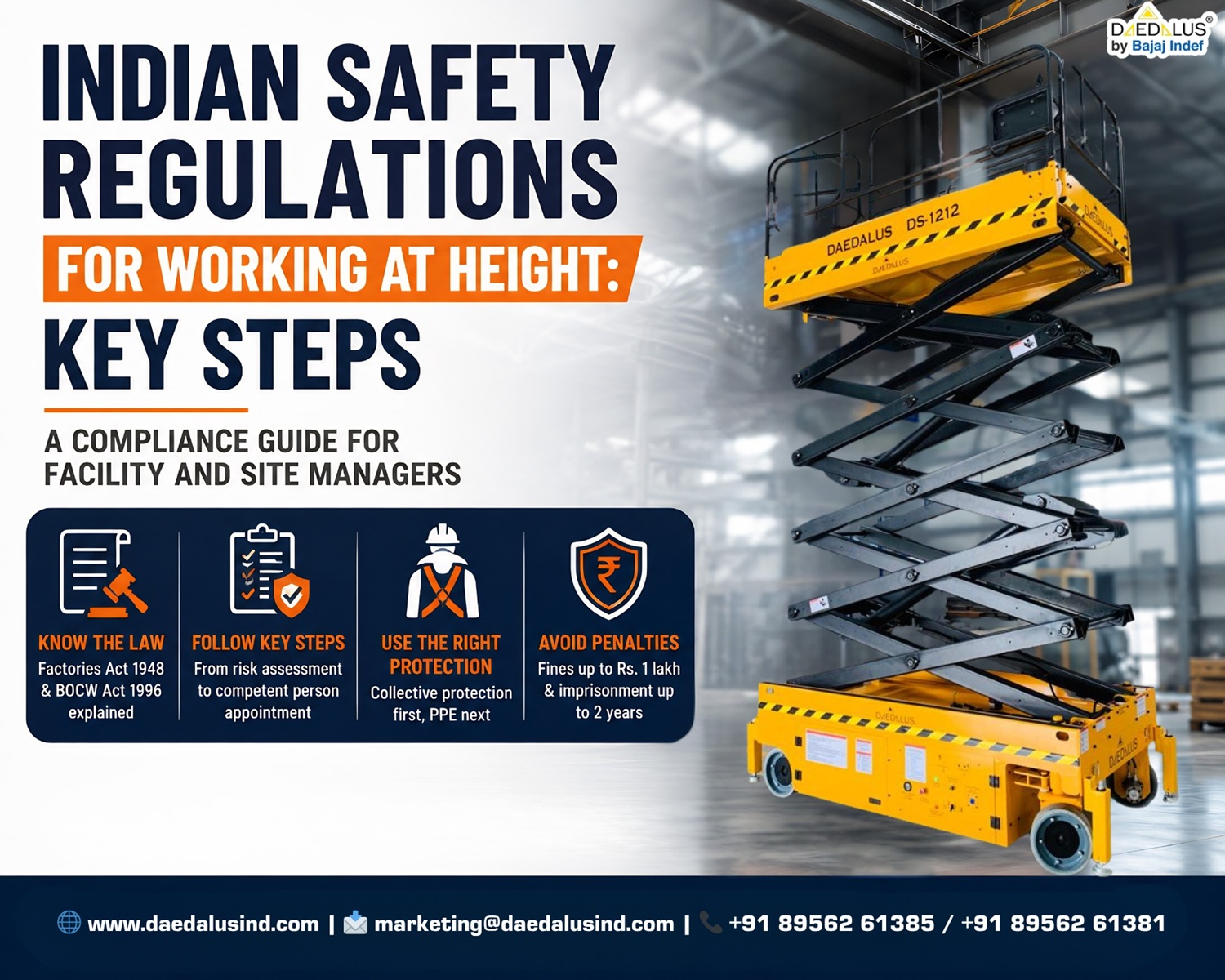
Indian safety regulations for working at height sit under two main laws: the Factories Act 1948 (for manufacturing and warehouse facilities) and the BOCW Act 1996 (for construction sites). Non-compliance can mean fines up to Rs. 1 lakh and imprisonment up to 2 years. This guide breaks down exactly which laws apply to your worksite, what you must have in place, and how CE-certified MEWPs help you meet every requirement.
Your worker just fell from a mezzanine. The inspector is at the gate. Do you know which Indian safety regulation you're being checked against?
Most facility managers and EHS officers don't. Not because they don't care about worker safety, but because India's legal framework for working at height is spread across multiple acts, state rules, and BIS standards. It's not one clean document you can print and follow.
Falls from height remain one of the top three causes of fatal workplace injuries in India. And in most cases, the employer is found liable because the right equipment wasn't in place or the paperwork didn't exist.
This guide cuts through the confusion. You'll know exactly which Indian safety regulations for working at height apply to your site, what your legal obligations are step by step, what penalties you face if you fall short, and how the right access equipment helps you stay compliant.
Let's get into it.
What Do Indian Laws Actually Say About Working at Height?
Under the Factories Act 1948, Section 32(c), any work where a person is likely to fall must have fencing or other protection in place, as far as is reasonably practicable. The law does not set a universal height threshold the way the US does (OSHA uses 4 feet for general industry). In India, the standard is practical risk: if a fall could injure someone, protection is required.
The Factories Act 1948 defines working at height as any work above ground level where a fall of more than two metres is possible. Section 33 also requires every dangerous opening in a floor, pit, or sump to be securely covered or fenced.
For construction sites, the Building and Other Construction Workers (BOCW) Act 1996 and its Central Rules 1998 govern height safety. This act covers scaffolding, access equipment, lifting appliances, and the duties of employers when workers operate at elevation.
Two additional standards apply across both sectors.IS 3696 Part 2 from the Bureau of Indian Standards covers fall prevention at construction sites. IS 3521 sets the standard for personal fall protection harnesses. These are not optional references; they're the technical benchmarks inspectors use.
The key takeaway: Indian law places the burden squarely on the employer. Ignorance of which act applies to your site is not a defence.
Which Regulations Apply to Your Worksite?
The law you need to comply with depends on what your site does, not just what height work you're doing.
Manufacturing and warehouse facilities fall under the Factories Act 1948. This applies if your premises uses power and employs 10 or more workers, or employs 20 or more workers without power use. Your legal obligations for height work sit primarily in Sections 32 and 33. If you employ 1,000 or more workers,Section 40B also requires you to appoint a dedicated safety officer.
Construction, infrastructure, and civil works sites fall under the BOCW Act 1996. This includes building construction, road works, bridges, power transmission lines, and any structure where workers are employed in building or demolition activity.
Overlap situations are common. A warehouse undergoing expansion or fit-out, for example, has its regular operations under the Factories Act while the construction activity on site pulls in BOCW Act obligations simultaneously. Both sets of requirements apply at the same time.
For indoor facility work at height, self-propelled scissor lifts provide an enclosed, stable working platform that directly satisfies the fencing and fall protection obligations under Section 32(c). This removes the need to erect and inspect scaffolding for each task.
What Steps Must an Employer Complete Before Work Begins at Height?
Indian law requires employers to follow a structured sequence of controls before any elevated work starts. The hierarchy, drawn from the Factories Act obligations and ILO guidance referenced in Indian safety frameworks, is: eliminate the risk first, then use collective protection, and only then rely on personal protective equipment.
Here are the five steps you must document:
Step 1: Hazard identification. Walk the site. Identify every location where a worker could fall. Note the surface type, proximity to edges, and any overhead obstructions.
Step 2: Risk assessment. For each hazard, evaluate the likelihood and severity of a fall. This is a written document, not a mental checklist. An inspector will ask for it.
Step 3: Permit to work. For high-risk tasks at elevation, a formal permit-to-work system is required. This ensures safety checks are completed and signed off before work begins.
Step 4: Equipment selection. Choose the right access equipment for the task, surface, and height. A scissor lift on a flat warehouse floor is a different compliance decision from a rough terrain unit on a construction site. Working at height safety training guidance notes that proper equipment selection also reduces insurance premiums and improves audit outcomes.
Step 5: Appoint a competent person. Indian law requires a qualified supervisor to oversee elevated work. This person must have the technical knowledge to identify hazards and enforce safe procedures on site.
Skipping any of these steps doesn't just create risk. It creates documented non-compliance that becomes exhibit A in any prosecution.
What Fall Protection Equipment Does Indian Law Require?
Under the Factories Act and BOCW Act, Indian law requires a layered approach to fall protection. Collective protections (guardrails, toe-boards, safety nets) take priority over personal protective equipment. PPE like harnesses and helmets are required in addition to, not instead of, collective barriers.
For MEWP-based height work specifically, the requirements differ by machine type. For articulating boom lifts,international MEWP safety guidance requires a full-body harness with a short restraint-type lanyard anchored to a designated point on the machine. This protects against the risk of being thrown from the platform during a boom swing or sudden movement.
For scissor lifts and vertical mast lifts, the enclosed platform and guardrail system already provides collective protection. The JIB Master vertical mast lift and DS-series scissor lifts from Daedalus are designed with guardrails that meet CE/EN 280 standards. This is above the baseline required under IS 3696 for equivalent scaffolding systems.
The BOCW Central Rules 1998 also place a clear duty on employers: you must not allow any lifting appliance or access equipment to be used if it does not comply with the prescribed standards. Using uncertified or unserviced equipment is itself a violation, separate from whether an accident occurs.
Daedalus machines include the Daedalus Intelligent Vehicle Control System (DIVCS), which provides tilt protection and electromagnetic brakes as built-in safety features. These are not extras. They are engineering controls that directly satisfy the fall prevention requirement under Section 32(c) of the Factories Act.
The Real Cost of Non-Compliance: Penalties Under Indian Law
This is where most EHS officers sit up straight.
Under Sections 92 to 106A of the Factories Act, a first violation can result in imprisonment for up to two years, a fine of up to Rs. 1 lakh, or both. If the same violation continues after the first conviction, an additional fine of up to Rs. 1,000 per day can be imposed for every day the violation persists.
A second offence carries imprisonment of up to three years and a fine up to Rs. 2 lakh.
Where non-compliance causes a worker's death, the factory manager faces an additional fine on top of the standard penalties. Both the occupier and the manager are personally liable. The company registration does not shield individuals.
Under the BOCW Act, a separate penalty framework applies to construction site violations. Employers who allow non-compliant equipment on site or fail to provide required safety infrastructure face prosecution under the Act's own provisions.
Beyond the criminal track, there's civil exposure. A worker injured in a fall can file for compensation under the Workmen's Compensation Act. Legal costs, compensation payments, and downtime typically far exceed the cost of the right equipment in the first place.
The practical takeaway: regular 6-monthly inspections of your MEWPs (as recommended under international MEWP maintenance guidance) create a documented maintenance record. That record is your legal protection in a prosecution.
How Does a CE-Certified MEWP Help You Stay Compliant?
A CE-certified MEWP, built to EN 280 standards, delivers built-in fall protection through an enclosed working platform, integral guardrails, tilt protection, and electromagnetic braking systems. This directly satisfies the Factories Act Section 32(c) fencing obligation and the BOCW Act's requirement for compliant lifting appliances. It removes the setup, inspection, and dismantling cycle that scaffolding requires.
Scaffolding is still used widely across Indian worksites. But every time scaffolding goes up, it requires inspection by a competent person before use, compliance with IS 3696, and documentation that the structure is safe. A poorly erected scaffold is itself a non-compliance event under both the Factories Act and BOCW Act.
A MEWP eliminates that risk. It arrives certified, it's inspected on a fixed schedule, and its safety features are engineered in. Rough terrain scissor lifts extend this compliance assurance to outdoor and uneven surfaces on construction sites, where BOCW Act obligations are most acute.
Daedalus MEWPs are designed and manufactured in India to CE/EN 280 standards. They use 85% locally sourced components and carry class-leading certification. Our pan-India service network ensures that your equipment stays inspected, documented, and compliant, wherever your worksite is located.
The inspection records Daedalus service engineers produce are exactly the kind of documented evidence that satisfies an inspector and protects you in court.
Conclusion
Three things matter most when it comes to height safety compliance in India.
First, know which law applies to your site. The Factories Act 1948 covers manufacturing and warehouse operations. The BOCW Act 1996 covers construction activity. Both can apply at the same time on one site.
Second, follow the right hierarchy. Eliminate the risk first. If you can't, use collective fall protection. PPE comes last, not first.
Third, document everything. Risk assessments, permits to work, equipment inspection records, and competent person appointments are your legal defence.
The right access equipment makes all three significantly easier. A CE-certified MEWP replaces scaffolding complexity with built-in fall protection and a clear inspection schedule.
Your worksite's compliance starts with the right equipment decision. Talk to the Daedalus team about which MEWP fits your site type, working height, and legal obligations. Call +91 8956261385 or email sales@daedalusind.com for a no-obligation consultation. Our engineers know Indian worksites and will help you match the right machine to your compliance requirements.
Frequently Asked Questions
What height is considered "working at height" under Indian law?
The Factories Act 1948 treats any work as working at height where a person could fall and be injured if precautions aren't in place. A common operational threshold used in Indian safety practice is a fall distance of more than two metres. This is stricter than the US OSHA standard of 4 feet for general industry. If your workers are on a raised platform, near an open edge, or above a floor opening, height safety rules apply.
Is a scissor lift or boom lift better for satisfying Indian height safety regulations on indoor sites?
For indoor, level-surface applications in warehouses or manufacturing facilities, a self-propelled scissor lift is typically the more practical compliance choice. It provides an enclosed platform with integral guardrails, satisfying the Factories Act Section 32(c) fencing requirement without additional infrastructure. Boom lifts offer greater outreach and are used where work must be done over obstacles or at irregular positions. Both machine types, when CE-certified, satisfy the legal requirement for compliant lifting appliances under the BOCW Act.
Does the Factories Act apply to construction sites, or only manufacturing facilities?
The Factories Act 1948 applies to premises where a manufacturing process is carried out and where 10 or more workers are employed using power (or 20 or more without power). It does not cover general construction activity. Construction, infrastructure, and civil works sites fall under the BOCW Act 1996 and its Central Rules 1998. However, a factory that is expanding or undergoing renovation may have both the Factories Act and BOCW Act applying simultaneously to different activities on the same premises.
What documents must an employer keep to prove compliance during a height safety inspection?
An inspector will typically look for: a written risk assessment for the elevated work activity; a permit-to-work record for high-risk jobs; proof of competent person appointment; equipment inspection certificates (MEWPs should be inspected by a competent person at least every six months, as noted in international MEWP inspection guidance); training records for workers operating at height; and a documented emergency response plan. Gaps in any of these records can be treated as a violation independent of whether an accident has occurred.
Are CE-certified MEWPs legally acceptable for use on Indian worksites?
Yes. CE certification to EN 280 is internationally recognised and accepted by Indian safety authorities as evidence of compliance with design and safety standards for MEWPs. The BOCW Central Rules 1998 require lifting appliances to conform to relevant standards, including those approved by the Bureau of Indian Standards or internationally equivalent standards. Daedalus MEWPs are fully designed and manufactured to CE/EN 280 standards in India, which means they satisfy both the international certification requirement and the Make-in-India procurement preference for Indian buyers.
