
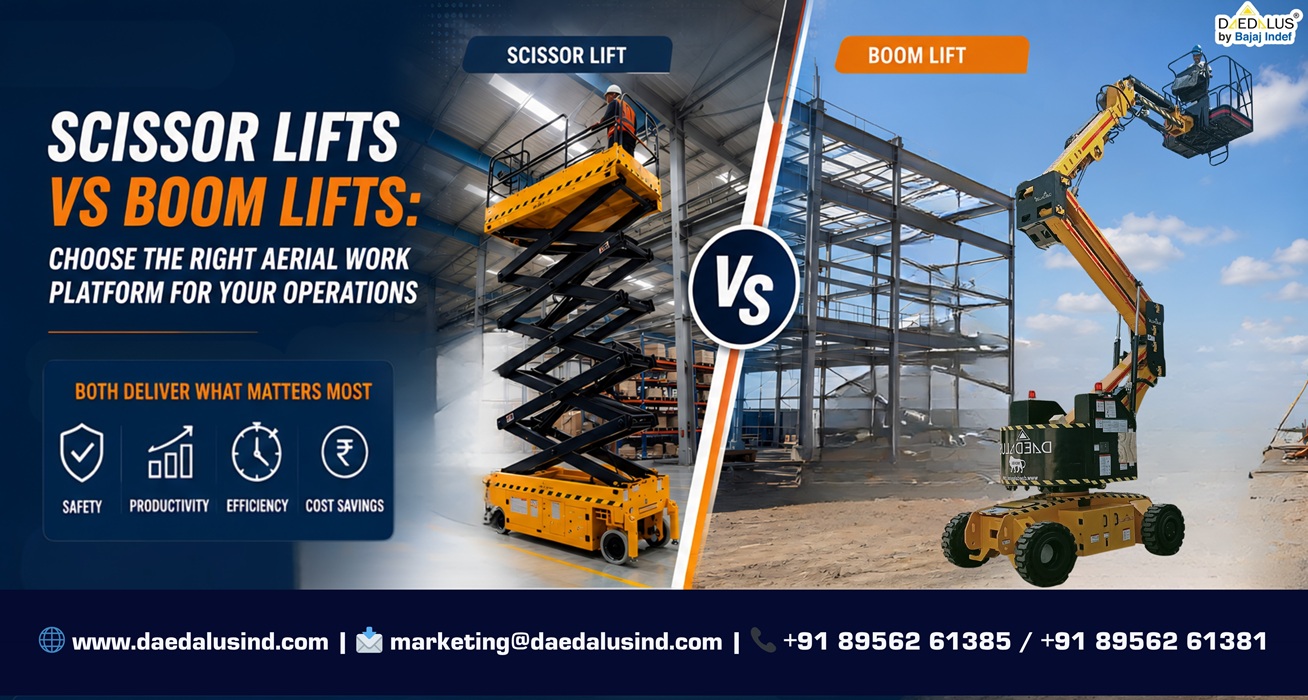
Choosing between a scissor lift and a boom lift depends on your worksite, height needs, and the type of access you require. Scissor lifts work best for vertical indoor tasks on flat surfaces where you need a large platform for multiple workers. Boom lifts excel at reaching over obstacles, working outdoors at greater heights, and accessing tight or elevated areas. This guide breaks down both options clearly so you can choose the right machine for your industry in India — and stop paying for capability you don't need.
More than 60% of workplace injuries at height happen because teams use the wrong access equipment for the job. In India, where industries like pharmaceuticals, aviation, warehousing, and infrastructure are growing at record pace, getting this decision right matters more than ever.
The India aerial work platform market reached USD 0.90 billion in 2024 and is projected to reach USD 1.50 billion by 2033. More Indian companies are buying or renting MEWPs (Mobile Elevating Work Platforms) than ever before. But the scissor lift vs boom lift question still confuses a lot of buyers.
This guide gives you a clear, no-jargon answer. We compare both machines across height, terrain, load capacity, safety, cost, and industry fit — so you walk away knowing exactly which one your team needs.
What is a Scissor Lift?
A scissor lift is a vertical aerial work platform that raises workers straight up using a criss-crossing metal support system. It moves only in one direction: up and down. It does not extend horizontally. What it lacks in reach, it makes up for in platform size, stability, and ease of operation.
When the supports expand, the platform rises. When they retract, the platform lowers. Scissor lifts are the go-to machine when your team needs to work directly overhead — painting ceilings, installing electrical fixtures, maintaining HVAC systems, or stacking racking in a warehouse.
A typical scissor lift platform is large enough for 2 to 4 workers along with tools and materials. That makes it ideal for tasks where the whole crew works together at height. At Daedalus, we make three types of scissor lifts for the Indian market:
- Self Propelled Slab Scissor Lift — battery-operated, ideal for smooth indoor floors like warehouses, factories, and airports
- Rough Terrain Slab Scissor Lift — built for outdoor and uneven surfaces, with 2WD drive and a larger battery pack
- Manual Pushable Scissor Lift — lightweight, low-cost, and easy to move in tight indoor spaces
All Daedalus scissor lifts are CE-certified to EN 280 standards and feature our proprietary Intelligent Vehicle Control System (IVCS) for easier operation and real-time fault detection.
What is a Boom Lift?
A boom lift is an aerial platform mounted on a hydraulic arm that can extend both vertically and horizontally. This arm lets operators reach up, over, and around obstacles. It is the right machine when a scissor lift cannot position directly below the work area due to structural obstacles, required height, or horizontal reach.
There are two main types of boom lifts used in Indian industry:
- Telescopic Boom Lift — a straight arm that extends outward for maximum height and reach, ideal for large open sites
- Articulating Boom Lift — a jointed arm that bends around obstacles, perfect for complex worksites with structural obstructions
Daedalus articulating boom lifts have working heights from 12m to 20m. The Daedalus JIB Master vertical mast lift is a popular choice for congested indoor environments, combining zero tail swing with 340 degree turret rotation to access spaces where no other machine fits.
Scissor Lift vs Boom Lift: Head-to-Head Comparison
Here is how the two machines stack up across the factors that matter most on an Indian worksite:
|
Feature |
Scissor Lift |
Boom Lift |
Winner |
|
Max Height |
6m to 18m |
12m to 20m+ |
Boom Lift |
|
Platform Size |
Large (2-4 workers) |
Small (1-2 workers) |
Scissor Lift |
|
Load Capacity |
Up to 1,000 kg |
200-250 kg |
Scissor Lift |
|
Horizontal Reach |
None (vertical only) |
Up to 10m+ |
Boom Lift |
|
Indoor Use |
Ideal |
Limited |
Scissor Lift |
|
Rough Terrain |
RT variant available |
Yes |
Boom Lift |
|
Tight Spaces |
Excellent |
Moderate |
Scissor Lift |
|
Purchase Cost |
Lower |
Higher |
Scissor Lift |
|
Running Cost |
Lower |
Higher |
Scissor Lift |
|
Training Needed |
Basic |
Advanced |
Scissor Lift |
1. Height and Reach
Scissor lifts typically reach working heights of 6m to 18m. They move only vertically, so you need to position the machine directly below your work area.
Boom lifts can reach much higher — up to 20m and beyond — and extend horizontally as well. You can position the boom lift away from the wall or obstacle and still reach the work area with the arm.
Verdict: Use a boom lift when height above 18m or horizontal reach is needed. Use a scissor lift for overhead work at moderate heights.
2. Platform Size and Load Capacity
This is where scissor lifts win clearly. Scissor lift platforms can carry up to 1,000 kg and comfortably hold multiple workers with tools and materials. Boom lift baskets are much smaller — designed for 1 to 2 people with a load capacity of around 200 to 250 kg.
Verdict: Scissor lifts win on platform size and load capacity every time. If your job requires a crew working together at height, choose a scissor lift.
3. Terrain and Environment
Scissor lifts are excellent for smooth, level surfaces like factory floors, warehouse aisles, pharmaceutical facilities, and airports. Rough terrain variants work on outdoor construction sites but need relatively stable ground.
Boom lifts handle more challenging conditions. Their outriggers and heavy chassis give better stability on uneven ground. They are the go-to choice for outdoor construction, infrastructure projects, and complex access tasks.
Verdict: For indoor flat floors, choose a scissor lift. For outdoor rough terrain or access over structures, choose a boom lift.
4. Maneuverability in Tight Spaces
This surprises many buyers. Scissor lifts are actually more compact and easier to drive in narrow aisles. Daedalus scissor lifts feature proportional drive control, letting operators maneuver precisely in tight warehouse and factory environments.
For truly congested spaces, the Daedalus JIB Master is worth considering. Its zero tail swing and 340 degree rotation let it work in spaces where nothing else fits.
Verdict: Scissor lifts and vertical mast lifts win for compact indoor maneuverability.
5. Safety Requirements
Both machine types follow MEWP safety guidelines under EN 280 standards. Scissor lifts have guardrails around the platform and a lower center of gravity, making them more stable. Boom lifts require workers to wear full-body harnesses at all times due to the risk of falling from an elevated, angled position.
All Daedalus products include tilt protection, electromagnetic brakes, and smart battery charger diagnostics — safety features designed specifically for Indian worksites.
Verdict: Both are safe when used correctly. Scissor lifts have a gentler learning curve and lower operator training requirements.
6. Purchase and Running Costs
Scissor lifts are consistently more affordable. They cost less to buy, less to rent, and less to maintain. Boom lifts cost significantly more to operate due to their complexity. If you don't need the extra reach, you're paying for capability you're not using.
Daedalus products are manufactured in India with 85% locally sourced components — keeping costs lower than imported machines from JLG or Genie, without sacrificing CE certification or quality.
Verdict: Scissor lifts offer better value for most indoor and semi-outdoor Indian applications.
Which Industries in India Need a Scissor Lift?
Scissor lifts are the right choice for these sectors:
- Warehousing and Logistics: India's warehouse sector is booming. Scissor lifts are ideal for stock picking, racking installation, and overhead maintenance on smooth warehouse floors.
- Pharmaceuticals: Cleanroom-compatible electric scissor lifts are widely used in pharma plants for equipment maintenance, piping, and HVAC access.
- Railways and Metro Rail: Indian Railways uses scissor lifts for overhead maintenance, carriage servicing, and platform infrastructure work.
- Automotive Manufacturing: Car plants use scissor lifts for assembly line work at elevated positions, especially on flat production floors.
- Airports: The Airport Authority of India uses scissor lifts for aircraft maintenance bay access, terminal interior work, and runway infrastructure maintenance.
Which Industries in India Need a Boom Lift?
Boom lifts are the right choice for these sectors:
- Space and Defense (ISRO, HAL, BARC): These organizations need boom lifts for reaching complex rocket assembly structures, satellite servicing, and tall hangar maintenance where obstacles must be navigated.
- Construction and Infrastructure: High-rise building construction, bridge work, and large infrastructure projects need the height and horizontal reach that only boom lifts provide.
- Power and Utilities (NTPC, Indian Oil): Substation maintenance, power line work, and large plant servicing require booms to reach above machinery, tanks, and structural obstacles.
- Aviation MRO: Aircraft maintenance and repair requires both scissor lifts (for wide-body access from below) and boom lifts (for reaching engine pylons and tail sections).
Quick Decision Guide: Which Machine Do You Need?
Match your worksite scenario to the right machine:
|
Your Worksite Scenario |
Best Choice |
|
Indoor factory or warehouse, flat floor |
Scissor Lift |
|
Outdoor construction site, rough terrain |
Rough Terrain Scissor Lift or Boom Lift |
|
Need to reach over machinery or structures |
Boom Lift (Articulating) |
|
Multiple workers on platform at once |
Scissor Lift |
|
Working height above 18m |
Boom Lift |
|
Tight indoor spaces, narrow aisles |
Scissor Lift or Vertical Mast Lift |
|
Pharmaceutical / cleanroom environment |
Scissor Lift (electric) |
|
Aviation / aerospace maintenance |
Both (task dependent) |
|
Budget-conscious purchase decision |
Scissor Lift |
Still not sure? The Daedalus team can help you choose based on your exact worksite requirements. As India's only CE-certified indigenous MEWP manufacturer, we have worked with clients across ISRO, Indian Railways, Aditya Birla, Siemens, and more.
Conclusion
The scissor lift vs boom lift decision doesn't have to be complicated. Scissor lifts are the workhorse for indoor, flat-surface applications where you need a stable platform for multiple workers at moderate heights. Boom lifts are the specialist tool when you need to reach high, reach far, or navigate around obstacles.For most Indian industries — warehousing, pharmaceuticals, manufacturing, railways, airports — a scissor lift is the right starting point. For defense, space, construction, and utilities, a boom lift gives you the reach and flexibility the job demands.
At Daedalus, we manufacture both. All our machines are built in India, certified to CE (EN 280) standards, and backed by a pan-India service network.
Contact the Daedalus team today: daedalusind.com/contact | +91 8956261385 / +91 8956261381
